
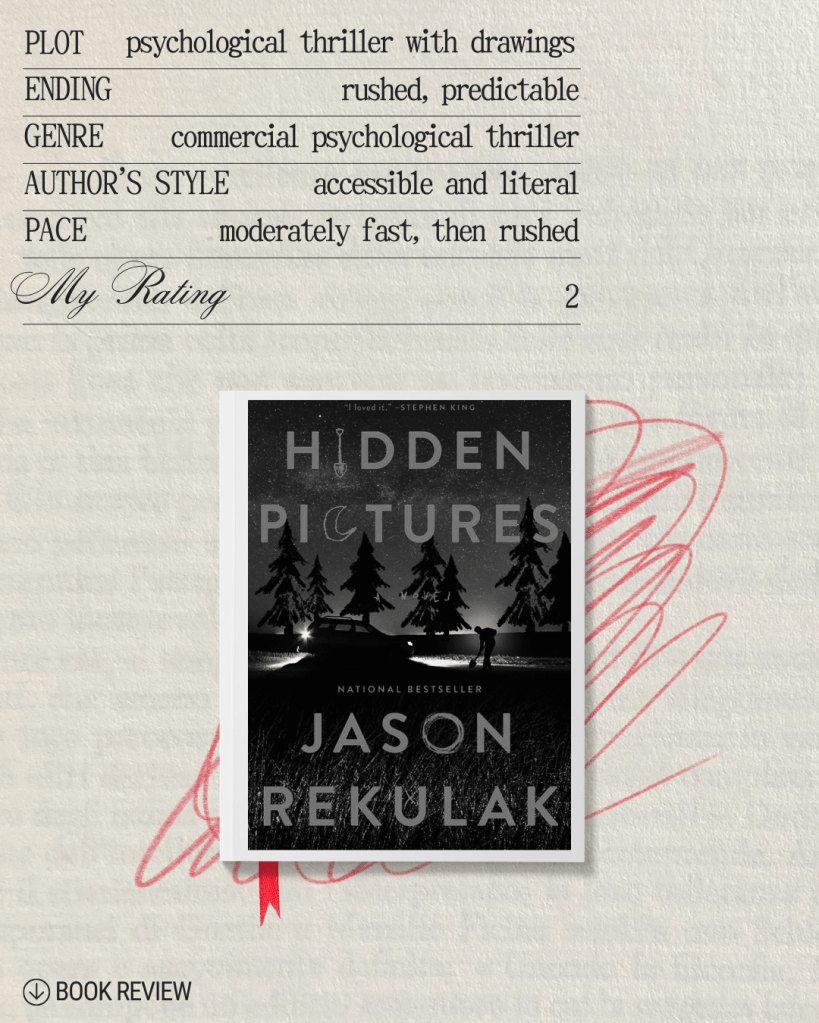
I picked up Hidden Pictures because I’d recently read Strange Pictures by Uketsu and enjoyed how much the narrative relied on visual implication over explanation. That book understands what makes images unsettling is what they refuse to clarify and knows how to create psychological tension from those drawings alone. So naturally, I immediately went looking for a book that might give me a similar reading experience and stumbled upon Hidden Pictures. A lot of people claimed I’d love it if I enjoyed Strange Pictures. Because it was positioned like a natural follow-up—another psychological thriller that uses drawings as narrative evidence rather than decoration—it was enough to convince me.
Overview of the Book
The premise is interesting. Mallory Quinn, newly sober and trying to put her life back together, takes a job as a babysitter with a wealthy family. The work offers structure, privacy, and a sense of routine—things she’s been missing. She also grows attached to the child she’s caring for: Teddy, a five-year-old who communicates more easily through drawing than conversation.
The drawings start out ordinary enough, but gradually they become more detailed, darker, and increasingly unsettling (I guess), raising questions about how much a child can observe and understand. As Mallory pays closer attention, she begins to suspect that the drawings may be connected to a long-unsolved murder, possibly through something she can’t quite explain.
Unsure whether she’s reading too much into the situation, Mallory decides to investigate further and look closer, even as doing so threatens the stability she’s worked hard to regain.
Reading Notes/Review
For me, this is a really strong setup. Children’s art, in my opinion, is effective precisely because it’s ambiguous and sits between innocence and accusation. Early on, I think the book understands that and for a while, the novel allows that unease to build up without exactly naming it. Except that restraint doesn’t last.
Fairly early into the book—about a quarter of the way in—it became very very clear to me where the story was headed and I’d already guessed the plot twist. I don’t mean that in a smug, puzzle-solving sense, but a more structural one. When the plot reveals itself early, the tension drops; and I think tension is so important for thriller novels. As soon as I got that feeling, I found myself reading not out of curiosity for what happens next but as a way to confirm what I’d already started to suspect. And I was right.
Predictability isn’t inherently a flaw. Plenty of good novels hint their endings though in shaper, wittier ways and still manage to hold attention. With Hidden Pictures, that trajectory becomes clear quickly and the book follows that path without much deviation. Though I should say that it tried really hard to do just that, however none of it is subtle enough to feel convincing. And maybe it’s simply a matter of taste, but for me, the clues were too obvious.
The big twist also felt rushed —honestly a bit corny, even. There’s nothing in it that feels particularly new or inventive within the genre. It’s revealed in a way that’s meant to shift the reader’s understanding of what came before it, and I understand that the initial theory presented in the story was written as narrative decoy. While I understand its purpose, I managed to see right through it almost immediately which spoiled the experience for me.
It also has a romantic subplot that contributes nothing to the plot. It doesn’t meaningfully shift the story nor add much weight to the characters. Instead, it feels forced… because I guess romance sells? Rather than adding depth to the narrative, it softens it and pulls attention away from the drawings and the unease they intend to create in the first place.
Anyway, I found the ending quite boring. It was one explanation after another, each neatly spelled out and actually spoken by the characters themselves (and there were new characters introduced towards the end… was I supposed to just magically care about them?) which felt like convenient writing at that point. And the longer it went, the less room there was for interpretation. The result is a book that’s very easy to follow and finish, but difficult to feel unsettled by for long.
I didn’t dislike reading it. It’s accessible, fast-paced, and written to appeal to a wide audience. But it left little behind. The drawings—which are supposedly the most interesting element early on—lose their significance as soon as the book started explaining rather than showing. So for a story built around what’s hidden, Hidden Pictures is surprisingly eager to reveal itself. In the end, it feels less like a psychological thriller that trusts its reader, and more like one that wants to make sure everything is understood—explicitly and without much room for doubt and interpretation.
 all that you hold dear
Leave a comment